


WAQAS KHAN
About
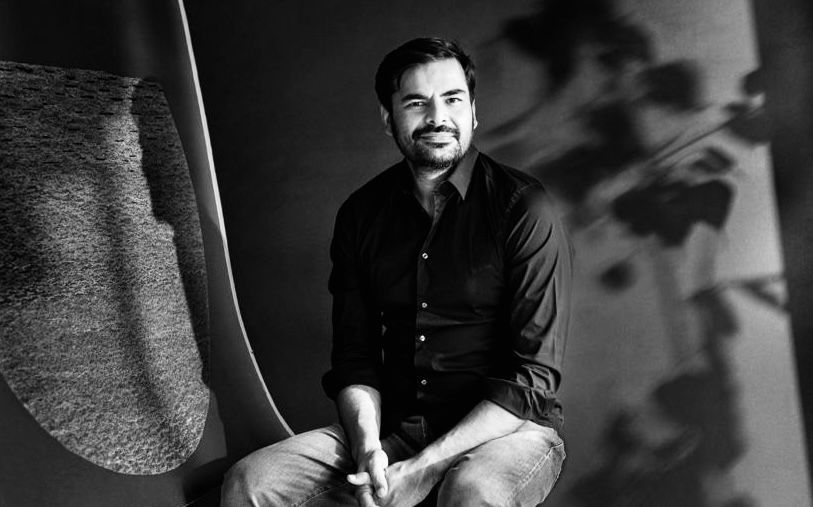
Waqas Khan (b. 1982, Akhtarabad; lives and works in Lahore) is one of Pakistan’s most compelling contemporary artists — a practitioner whose disciplined minimalism blooms into painstakingly detailed worlds. Trained in printmaking at the National College of Arts, Lahore (BFA, 2008), Khan has taken classical and vernacular line-based disciplines — Persian‑Mughal miniature labour, architectural drafting, weaving and calligraphic rhythm — and translated them into a singular visual dialect built from repetition, silence and rigorous manual labour. Khan’s methods are deceptively simple and radically patient. Working with a dowel — a draughtsman’s implement rather than a painterly brush — he applies millions of tiny dots, lines and stripes to paper using a technique informed by the Bardhakhat procedure. From a distance his surfaces read as printed fields or woven textiles; up close they resolve into discrete, human-made gestures. This oscillation between the mechanical and the handmade is central to his poetics: the eye is invited to travel across micro‑rhythms and return to the macro composition, creating a contemplative feedback loop between viewing and thought. Conceptually, Khan’s work locates itself at the intersection of material devotion and metaphysical inquiry. He draws explicit inspiration from Sufi poetics and the literature of mystic thought, where repetition becomes prayer and pattern functions as both meditation and map. His grids, webs and celestial forms are therefore both formal investigations and existential reflections — attempts to measure time, memory and the passing self through accumulated marks. Khan has described the work as a negotiation between outside and inside: formal signs that absorb the observer, reconfiguring perception into an inward experience. Technically meticulous yet emotionally resonant, Khan’s drawings and installations frequently deploy deliberate imperfections — densifications, pauses, irregularities — that disrupt any sense of cold seriality. These “interruptions” create organic rhythms, humanizing the work and refusing the sterility often associated with minimalism. The resulting compositions read as visual narratives or maps in which the viewer is an active participant, tracing routes, pausing at silences and discovering hidden resonances. Khan’s practice has received early and sustained international recognition. He was nominated for the Jameel Prize (2013), awarded the NDTV Spectrum Award for transformation in visual arts in South Asia and the ACTA award (2018), and has shown widely: Victoria & Albert Museum, London; Galerie Krinzinger (solo: History, Memory or Geometry, 2018); Drawingroom curated projects; Villa Empain, Brussels; 57th Venice Biennale (2017); Dhaka Art Summit (2016); NTU Singapore; Sharjah Museum of Islamic Civilization; Beijing Today Art Museum and Manchester Art Gallery, among others. His work is included in prestigious public collections such as the British Museum and the Victoria & Albert Museum (London), the Kiran Nadar Museum (India) and the Deutsche Bank Collection (Frankfurt), a testament to his international relevance and the cross‑cultural clarity of his visual language. Beyond gallery walls, Khan’s labour‑intensive method has been influential within a generation of South Asian artists seeking to reconcile craft traditions with contemporary conceptual practices. He marries a minimalist restraint with a devotional approach to mark‑making; his works are at once exacting and generative, austere and alive. Waqas Khan’s art asks that we slow down. Through patient accumulation he converts repetition into revelation, and in that alchemy of time and touch his drawings become contemplative instruments — maps for reading history, memory and the fragile geometry of human beings.