


SALMAN TOOR
About
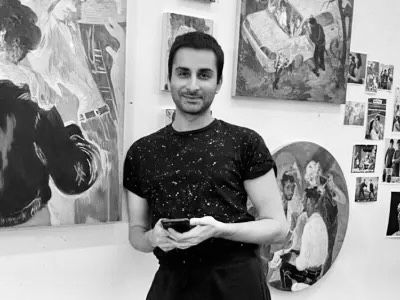
Salman Toor (b. 1983, Lahore, Pakistan) is a New York–based painter whose quietly radical figurative work reframes contemporary queer life through the intimate lives of young South Asian and Middle Eastern men. Trained in the United States—BFA, Ohio Wesleyan University (2006) and MFA, Pratt Institute (2009)—Toor synthesizes Western art‑historical methods with South Asian pictorial sensibilities to produce scenes at once tender, melancholic and formally exacting. His paintings map the emotional geographies of diaspora: moments of friendship, flirtation, longing and private ritual that reveal how identity, desire and cultural belonging are constructed across transnational lives. Toor’s subject matter revolves around recurring characters and settings: domestic interiors, apartments, late‑night gatherings, and the liminal spaces of queer nightlife. Series such as “Bar Boy” and individual works like How Will I Know (2020) investigate nocturnal social worlds where desire, performance and vulnerability intermix. Rather than sensationalize, Toor renders these scenes with a soft, attentive gaze—figures linger, look away, or meet the viewer’s eye with ambiguous expression. Through compression of narrative and selective omission, his canvases invite projection and reflection, becoming both personal diary and social archive. Formally, Toor builds a distinctive visual language that blends influences from Mughal miniature painting, the opulent color of South Asian decorative traditions, and Western precedents—most notably the cinematic solitude of Edward Hopper and the psychological staging of modern figurative painting. He favors a warm, amber‑tinted palette and layered surfaces that generate interior light and atmospheric depth; color often functions narratively, indexing mood and memory rather than describing literal conditions. Toor’s compositional choices—cropped figures, flattened spaces, and jewel‑like details—evoke a hybrid pictorial syntax that resists simple categorization. Toor’s work gained broad institutional recognition with his inclusion in the 2020 Whitney Biennial and subsequent major solo presentations, including a solo exhibition at the Whitney Museum of American Art (2021) and a solo project at the Secession in Vienna (2022). These platforms amplified his voice internationally, bringing his nuanced portrayals of queer Muslim subjectivity into prominent public conversations about representation, migration and belonging. Critically, Toor’s paintings are praised for their empathetic complexity: they make visible a cohort of subjects often marginalized or rendered one‑dimensionally in both Western and South Asian contexts. Reviewers note his ability to balance narrative intimacy with painterly rigor—his pictures are at once accessible and layered, quietly political without resorting to didacticism. By focusing on friendship, domestic care, and quotidian ritual, Toor expands what visibility looks like for diasporic queer communities, creating visual spaces of recognition and tenderness. Beyond biography and exhibition history, Toor’s practice is a sustained inquiry into how personal archives—photographs, memories, clothing, music and place—mediate identity. His paintings function as repositories of small gestures: a cigarette shared between friends, a hand on a shoulder, a boy leaning into light. In these moments he finds the politics of everyday life: the slow accrual of belonging, the cost of displacement, and the quiet power of intimacy. Living and working in New York, Salman Toor continues to refine a body of work that is formally inventive, emotionally resonant and culturally urgent—offering a rich, humane reimagining of contemporary portraiture and the persistent possibility of care within diasporic queer life.